Energy Modelling
Preliminary energy calculations were carried out to assess the likely size of the fan and heating elements whilst also providing a comparison to a traditional HVAC system.
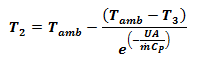
The following equations were acquired for the fan and heating element and the locations of the temperatures can be found in the figure provided.
The equal friction method allowed us to determine the duct friction pressure loss (F) at set pipe dimensions and if the velocity pressure is known. Using this method it was found that the fan must overcome a pressure drop of 0.105inWC (or 26.04 Pa) and provide a flow rate of 3 L/s.
The second equation looked at the thermal power (Qthem) from the heating element which will be needed to bring the air flow up to the necessary temperature when leaving the diffuser. It was also required to determine any heat loss through the pipe so a final equation was used to investigate this.
Using this method the temperature drop was found to be almost non-existent (around 0.004ºC) and the required element power was 61.68 W when the volume flow rate was 3 L/s. This relationship is linear i.e. when the volume flow rate is set to 5 L/s the required power is 102.8 W. Lastly it is expected that essentially all the electrical power is converted to heat (the heater is 100% efficient).
Full explanations of these methods are provided in section five of the interim report located on the home page and the full energy modellling excel document downloaded by following the link provided.